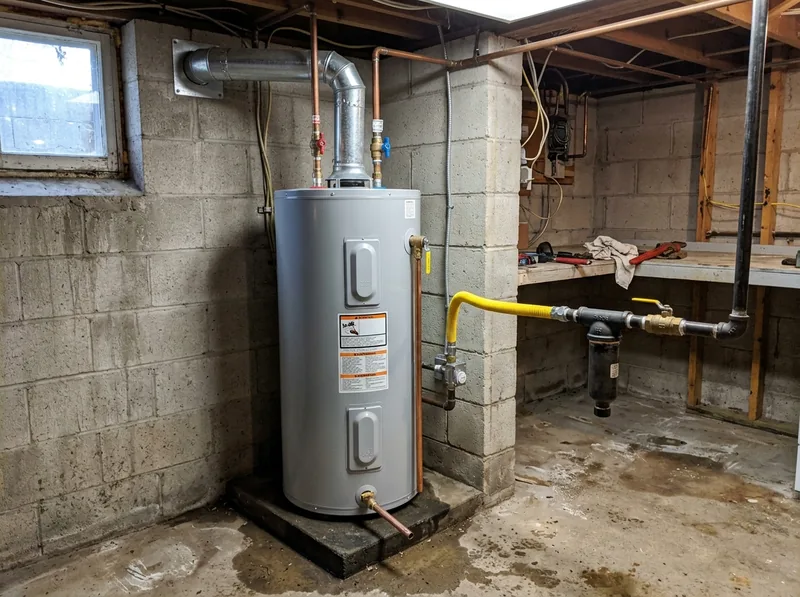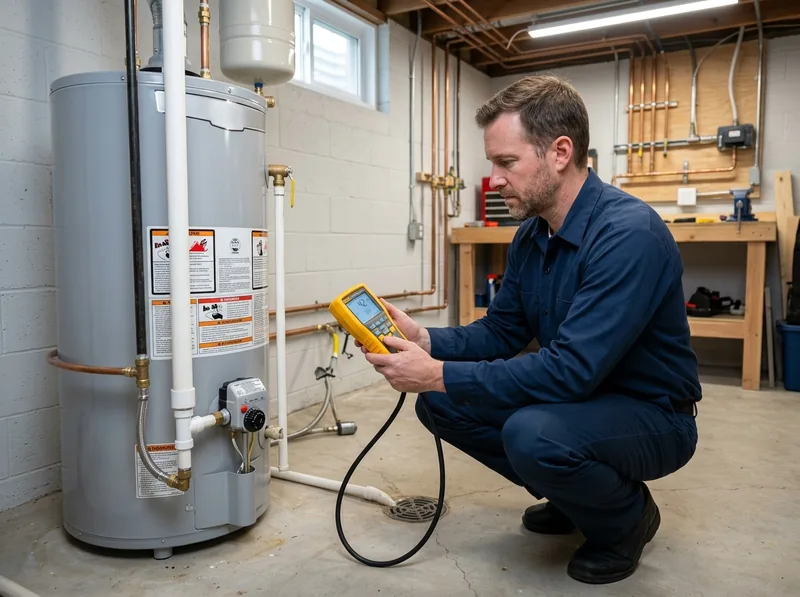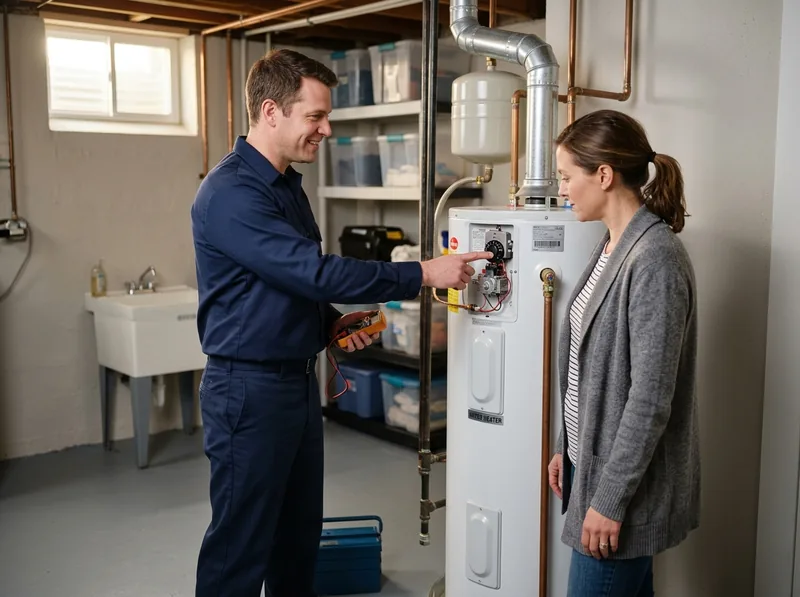
Start with the energy source. On electric heaters, check the breaker and the high-limit reset. On gas heaters, confirm the gas is on and the pilot or burner is lit. On tankless units, read the error code. If your hot water comes from the boiler, check that the boiler is running. If none of that restores hot water, a part has usually failed and a technician should take over.
Step 1: Identify the type of water heater you have
The checks depend on the system, and Connecticut homes use a wider mix than most. Look at the unit and match it to this table.
| What you see | Type |
|---|---|
| Tall tank with a metal flue pipe on top and a gas line with a control knob near the bottom | Gas or propane tank |
| Tall tank with an electrical cable at the top, two small access panels on the side and no flue | Electric tank |
| A box mounted on the wall, often with a digital display | Tankless (on-demand) |
| Insulated tank piped to the boiler, with no burner or elements of its own | Indirect-fired tank |
| No separate tank at all, and hot water lines connected to the boiler | Tankless coil in the boiler |
| Tank with its own oil burner at the bottom | Oil-fired water heater |
Step 2: Is it every faucet or just one?
If the kitchen has hot water but the bathroom sink doesn't, the water heater is probably fine. The problem is more likely the faucet's cartridge or the anti-scald valve in a shower. A water heater problem affects every fixture in the house.
Step 3: Electric water heater checks
- Check the breaker. Electric water heaters usually run on a double-pole 240-volt breaker. If it has tripped, reset it once.
- Check the high-limit reset. Many units have a red reset button (the ECO) behind the upper access panel. It trips if the water overheats. With the breaker off, pressing it once is reasonable, but do not touch any wiring.
- Wait and test. A full tank can take an hour or more to recover.
- If it trips again, stop. A breaker or reset that trips repeatedly points to a shorted element, a failing thermostat or loose wiring. That needs a pro. Our page on electric water heater repair explains the usual fixes.
Safety: the terminals behind the access panels carry 240 volts. Testing elements and thermostats is a job for a qualified technician.
Step 4: Gas and propane water heater checks
- Confirm the gas supply. Does the stove light? Propane households should check the tank gauge, since running out of propane is a common winter cause in rural Connecticut.
- Check the control knob. It should be set to "On", not "Pilot" or "Vacation".
- Look at the pilot or status light. Many newer units have a status light that blinks a code. The meaning is printed on the unit's label.
- Relight only by the label instructions. If the pilot lights but won't stay lit, read our guide on why a water heater pilot keeps going out.
If you smell gas: don't relight anything or use switches. Leave the house and call your gas utility or 911 from outside.
Step 5: Tankless water heater checks
Write down the error code first, because it tells the technician where to start. Then check that the unit has power, the gas is on and the water flow is high enough. Many tankless units won't fire at a trickle, so open the tap fully. Scale buildup and a clogged inlet filter are the most common causes, especially with hard or well water. See tankless water heater repair for details.
Step 6: Hot water from the boiler
If your hot water comes from an indirect tank or a tankless coil, a boiler problem stops both heat and hot water. Check that the boiler is running, that oil has been delivered and that the emergency switch, usually at the top of the basement stairs, is on. If the heat works but the hot water doesn't, a zone valve, circulator, aquastat or mixing valve has often failed. Our guide to indirect and oil-fired water heater repair covers these systems.
Why it often happens in winter
In a Connecticut winter, the water coming into the house is much colder, so the heater runs longer and harder to reach temperature. That extra load exposes weak elements, worn thermocouples and sediment-clogged tanks. When a part fails in January, it was often already worn.
When to call a professional
- The breaker or reset trips again
- The pilot won't stay lit after you follow the label instructions
- There's water around the tank. See water heater leak repair.
- You smell gas, see soot or the water is scalding hot
- The unit is more than about 10 years old and this is the second or third problem
We connect homeowners across the state with local pros for water heater repair in Connecticut. If your household needs hot water today, see our emergency water heater repair page.
Common questions
Why do I suddenly have no hot water?
The most common causes are a tripped breaker or high-limit reset on electric units, a pilot or ignition failure on gas units, an error lockout on tankless units, or a boiler problem when hot water comes from the boiler.
How long does a water heater take to heat up after a reset?
A full tank typically needs about an hour or more to recover, depending on its size and fuel type. Gas units usually recover faster than electric.